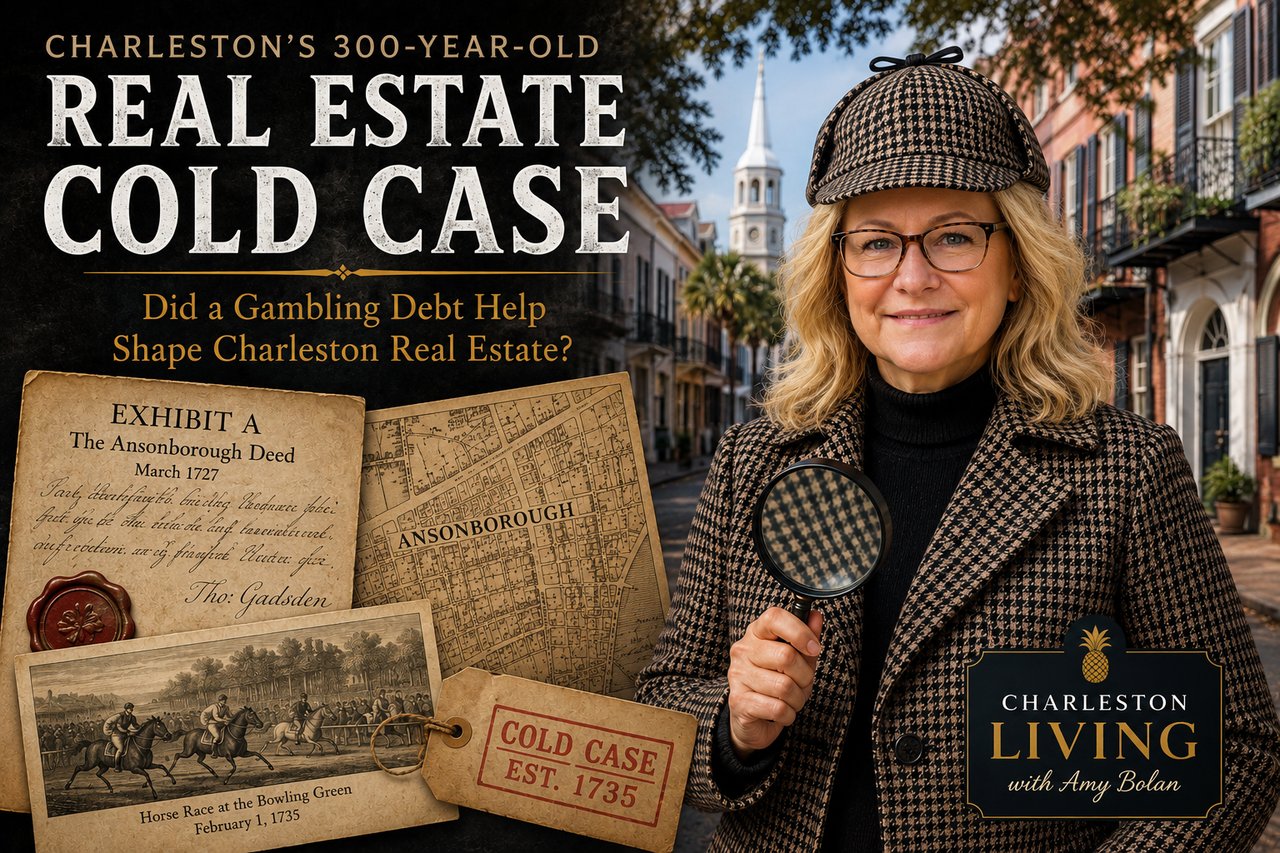
Charleston's 300-Year-Old Real Estate Cold Case
Did a Gambling Debt Help Shape Charleston Real Estate?
Charleston loves a good story.
And for nearly three centuries, one particularly colorful story has followed the historic neighborhood of Ansonborough: Captain George Anson supposedly won the land in a gambling game.
It's exactly the kind of tale Charleston does so well—wealth, gambling, real estate and just enough scandal to make us want to believe it.
There's only one problem.
The deed tells a different story.
So this week on Charleston Living, I'm putting on my investigator's hat—quite literally—and reopening one of Charleston's oldest real estate cold cases.
Because while the famous Ansonborough gambling story probably isn't true, another curious real estate transaction involving George Anson suggests that Charleston's old legend may not be entirely fiction.
Perhaps we've simply been telling the story about the wrong property.
Exhibit A: The Ansonborough Deed
George Anson was a young officer in Britain's Royal Navy who spent significant time in Charleston beginning in the 1720s.
In March 1727, Anson acquired a large tract immediately north of colonial Charles Town from Thomas Gadsden. The property would eventually become the heart of the neighborhood we now call Ansonborough. Historical research into the surviving records shows this was a documented purchase—not the spoils of a lucky night at the gaming table.
That would seem to settle the matter.
Case closed.
Except Charleston's gambling story persisted.
And historians have uncovered another series of transactions involving Anson that makes the legend considerably more interesting.
Enter Charles Codner
Charles Codner was a young South Carolina planter who inherited substantial property and wealth.
Unfortunately, he wasn't particularly successful at keeping it.
Within a relatively short period, Codner's financial circumstances deteriorated as he disposed of much of his inheritance. By 1735, his finances were sufficiently strained that property was moving through his hands.
And that year, George Anson and Charles Codner suddenly began doing real estate business together.
The surviving records document two transactions in April 1735. One involved an urban property at what is now the southeast corner of State Street and Unity Alley. Another involved a mortgage on approximately 350 acres on Daniel Island.
Why were these two men suddenly involved in substantial real estate transactions?
That's where our cold case becomes interesting.
The Bowling Green
Only a few months earlier, something else had been happening on Anson's Charleston property.
Anson called part of his plantation the Bowling Green.
Today, we think of Ansonborough as being firmly inside downtown Charleston. In the 1730s, however, this was suburban land just outside the small colonial town.
The Bowling Green became a popular recreational gathering place. Historical newspaper notices document horse-related activities, cockfighting, social gatherings and other entertainment there.
Then, on February 1, 1735, the Bowling Green hosted what historians believe is the earliest documented horse race in South Carolina.
Four horses competed in a one-mile heat, with a saddle and bridle offered as the prize. The surviving newspapers don't tell us who won.
But horse racing and wagering have a very long history together.
And just weeks later, financially troubled Charles Codner was transferring and mortgaging real estate to George Anson.
Was Real Estate Used to Settle a Bet?
This is where documented history ends and historical detective work begins.
Historian Dr. Nic Butler of the Charleston County Public Library has raised an intriguing possibility: Could Codner have owed Anson money from a wager and used real estate to satisfy the obligation?
Perhaps the wager involved the February horse race.
Perhaps it involved cards.
Perhaps there was no gambling debt whatsoever.
No surviving document proves that Codner lost a bet to Anson, and Butler is careful not to claim otherwise. What remains is circumstantial evidence surrounding a series of unusual transactions.
And there is another fascinating wrinkle.
English law at the time placed restrictions on using real property to satisfy gambling debts. If land were being transferred because of a wager, there would have been good reason for the parties to document the arrangement as an ordinary sale or mortgage instead.
Suddenly, Charleston's old gambling legend becomes a little harder to dismiss.
What Happened to Charles Codner?
The mystery didn't save Codner's fortune.
The historical record suggests he repaid the £500 currency mortgage obligation to Anson within the required two-year period, although no surviving record of the actual payment has been found. Codner then sold the same 350-acre Daniel Island tract to another party in 1737.
His financial decline continued.
By the time Charles Codner died in 1747, the once-prosperous heir had disposed of his remaining assets and died with very little property to his name.
George Anson's story went in quite a different direction.
He eventually left Charleston, continued his remarkable Royal Navy career, circumnavigated the globe and returned to England with captured Spanish treasure. He became one of Britain's most celebrated naval figures and ultimately Lord Anson, Baron of Soberton.
His Charleston property remained behind.
Beginning in 1745, his attorneys subdivided the former Bowling Green property into streets and residential lots.
The neighborhood became Ansonborough.
So What's the Verdict?
Did George Anson win Ansonborough in a gambling game?
The surviving evidence says no.
Did gambling nevertheless play a role in another Charleston real estate transaction involving George Anson?
Possibly.
We simply don't have enough evidence to close the case.
Perhaps Charleston remembered that George Anson, gambling and real estate belonged in the same story—but over nearly three centuries, attached the legend to the wrong property.
As a Realtor, I've seen some unusual terms in real estate transactions over the years.
But I have to admit...
A horse-racing debt has yet to appear on one of mine. 😂
For now, we'll have to leave this Charleston real estate cold case exactly where we found it:
Open. 🔎
And perhaps that's part of what makes Charleston so fascinating. Behind the houses, streets and neighborhoods we see every day are layers of stories—some documented, some legendary, and some still waiting for another clue.
Until next week… I'll see you around Charleston.