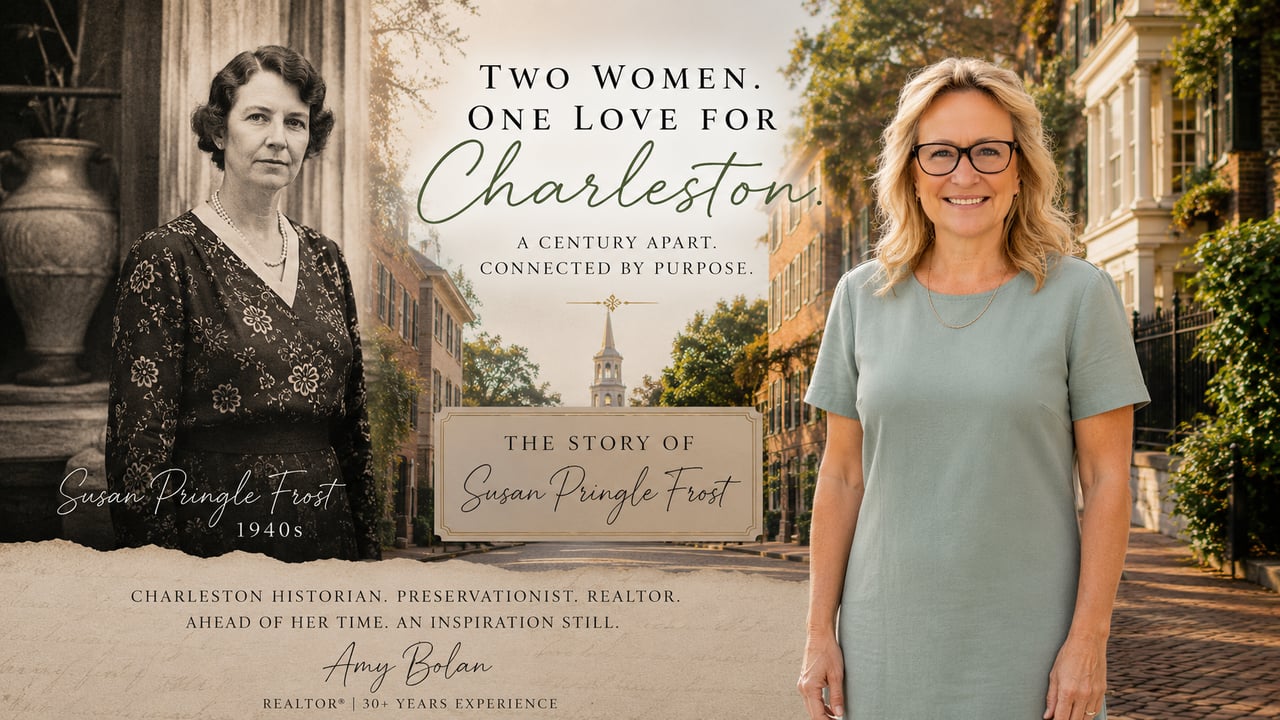
Every once in a while, I discover a Charleston story that feels a little personal.
This is one of them.
More than a century before I began selling real estate in Charleston, another woman was walking these same streets, looking at Charleston homes a little differently from many of the people around her.
Her name was Susan Pringle Frost.
She was a woman working in real estate at a time when few women were—and she saw something in Charleston's aging, neglected homes that many others didn't yet see.
She saw value. She saw history. And perhaps most importantly, she saw what Charleston stood to lose.
I couldn't help but feel a connection to her story.
Not because our careers were the same. They certainly weren't.
But because Susan understood something about real estate that I have come to understand after more than 30 years in this business:
Sometimes you have to look beyond what a property is today to see what it can mean tomorrow.
And in Susan's case, that ability to see possibility would help change Charleston forever.
A Woman Ahead of Her Time
Susan Pringle Frost was born in Charleston in 1873, into a prominent South Carolina family whose fortunes had suffered considerably after the Civil War.
By the early twentieth century, Susan needed to support herself.
At a time when professional opportunities for women were limited, she entered the business world and eventually established herself in real estate.
In 1909, she opened her own real estate office.
Think about that for a moment.
A woman building a real estate career in Charleston more than a century ago—before women in America even had the constitutional right to vote.
And Susan wasn't interested only in selling property.
She began looking at Charleston's old houses.
Many were deteriorating. Some had been neglected for years. Others were threatened by demolition as Charleston, like cities throughout America, began adapting to automobiles, commerce and twentieth-century development.
Where others saw obsolete buildings, Susan saw something worth saving.
Seeing Value Where Others Didn't
As a Realtor, this is the part of Susan's story I find especially fascinating.
She wasn't walking into beautifully restored Charleston showplaces.
She was looking at properties other people were willing to abandon—or tear down.
Susan began purchasing endangered historic houses, sometimes borrowing money to do it. She restored what she could and helped find preservation-minded buyers for others.
Her work included properties along Tradd Street, St. Michael's Alley and East Bay Street.
During the 1920s, she purchased six of the historic buildings that would eventually become part of one of Charleston's most recognizable landmarks:
Rainbow Row.
The colorful transformation we know today would come later, beginning with Dorothy Porcher Legge in the 1930s.
But Susan Pringle Frost had already looked at those neglected old buildings and decided they deserved a future.
The House That Helped Start a Movement
Then, in 1920, came a threat to one of Charleston's significant historic houses.
The Joseph Manigault House on Meeting Street had been acquired by the Charleston Motor Company, and its future was uncertain as commercial development expanded.
Susan and a group of concerned Charlestonians decided something had to be done.
On April 21, 1920, they gathered at a home on South Battery and organized the Society for the Preservation of Old Dwellings.
Susan Pringle Frost became its first president.
Today, we know that organization as the Preservation Society of Charleston—recognized as the nation's oldest community-based historic preservation organization.
What began with a group of people determined to protect Charleston's threatened architecture became something much larger.
It became a movement.
Saving More Than One House at a Time
Susan also understood something remarkably forward-thinking.
Saving individual houses wasn't going to be enough.
Charleston needed a way to protect the architectural character of entire neighborhoods.
Susan and other preservation advocates pushed city leaders toward broader protections for Charleston's historic buildings.
Then, in 1931, Charleston adopted a groundbreaking zoning ordinance establishing the Old and Historic District and creating what would become the Board of Architectural Review.
Charleston became a national pioneer in protecting an entire historic district through local law.
Other American cities would eventually follow Charleston's example.
Today, preservation regulations are simply part of living, owning property and practicing real estate in historic Charleston.
But someone had to imagine the idea before it existed.
Susan Pringle Frost was among the people who did.
Preservation Has a More Complicated Story, Too
Looking back more than a century later also allows us to see something early preservationists did not always fully consider.
Buildings aren't the only things that give a neighborhood its history.
People do, too.
Some areas targeted for restoration were home to Black Charlestonians and working-class families. As historic neighborhoods were restored and property values changed, longtime residents could also be displaced.
Modern historic preservation has therefore grown beyond simply asking, How do we save this building?
Today, it increasingly asks another important question:
How do we preserve the people, communities and stories that gave these places meaning in the first place?
That continuing conversation is also part of Charleston's story.
More Than a Century Later
Susan Pringle Frost died in 1960.
But walk through Charleston today and her influence is remarkably easy to find.
It's there along Tradd Street.
It's there on East Bay.
It's there in the historic houses visitors travel from around the world to see.
And it's there every time Charleston pauses before allowing something irreplaceable to disappear.
I've spent more than three decades in real estate, and I've often said that what we do is about much more than houses.
Susan Pringle Frost's story reminds me that this has been true for a very long time.
She saw homes as more than buildings to be bought and sold.
She saw history.
She saw possibility.
And she understood that once something irreplaceable disappears, no amount of money can truly bring it back.
I never knew Susan Pringle Frost, of course.
But more than a century after she began walking Charleston's streets as a woman in real estate, I find myself walking many of those same streets in the same profession.
And I have to admit...
I like knowing she walked them before me.
Until next week, I'll see you around Charleston.
— Amy