CHARLESTON LIVING WITH AMY BOLAN
The War Was Almost Over. So Why Did John Laurens Charge?
Charleston's Forgotten Revolutionary War Tragedy
By the summer of 1782, everyone knew the American Revolution was nearing its end.
Cornwallis had surrendered at Yorktown ten months earlier. Peace negotiations were underway across the Atlantic.
But Charleston was still occupied by the British.
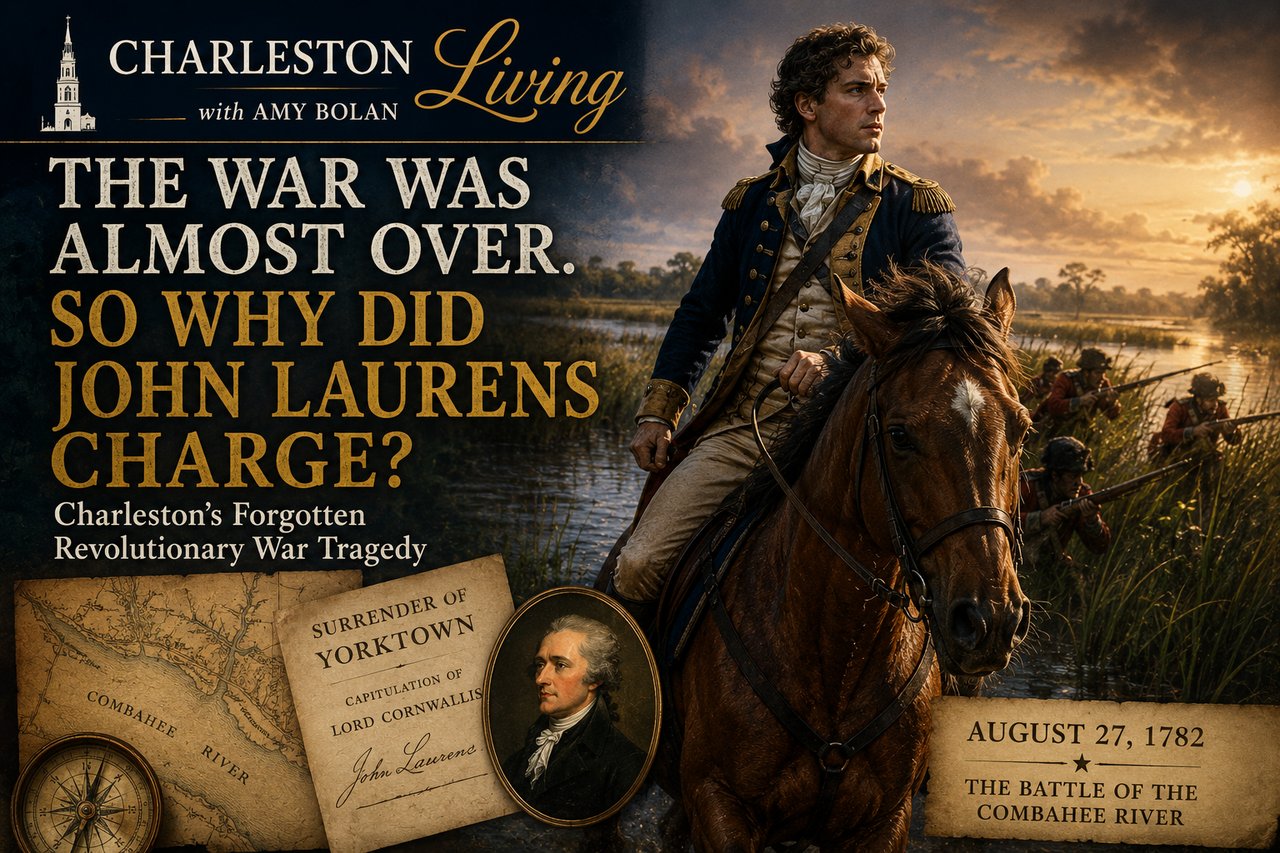
And on the morning of August 27, 1782, along the marshes of the Combahee River south of Charleston, a 27-year-old officer named John Laurens rode toward a British force waiting in the tall grass.
Within minutes, he was dead.
The tragedy wasn't simply that Laurens died so young.
It's that the battle may never have needed to happen at all.
And the young man who died there wasn't an obscure soldier.
He had fought beside George Washington.
He was one of Alexander Hamilton's closest friends.
He had helped storm Redoubt No. 10 at Yorktown.
He had helped negotiate the British surrender.
And he had spent years advocating a radical idea for his time: allowing enslaved men to fight for American independence in exchange for their freedom.
So how did John Laurens end up dying in an almost forgotten skirmish in the South Carolina Lowcountry?
That's where our story begins.
A Charleston Son
John Laurens was born in Charleston on October 28, 1754, into one of South Carolina's wealthiest planter families.
His father, Henry Laurens, became president of the Continental Congress and was deeply involved in the Atlantic slave trade.
That makes John's later views particularly striking.
While serving in the Continental Army, Laurens repeatedly advocated recruiting enslaved men into military service and ultimately freeing them. South Carolina's political leadership rejected his proposals.
But Laurens was more than an idealist.
He was also fearless.
Perhaps too fearless.
George Washington would later describe Laurens's courage as an “intrepidity bordering upon rashness.”
That description would prove hauntingly accurate.
Laurens, Hamilton and Yorktown
If you've seen Hamilton, John Laurens may already sound familiar.
In real life, Laurens and Alexander Hamilton were extremely close friends and served together in Washington's military family.
Laurens fought at Brandywine, Monmouth and Savannah. He was captured when Charleston fell to the British in 1780, later traveled to France on behalf of the American cause, and returned in time for the decisive campaign at Yorktown.
There, Laurens joined Hamilton in the dramatic assault on Redoubt No. 10.
Then Laurens was chosen to help negotiate the terms of Cornwallis's surrender.
Imagine that.
You're 26 years old.
You've helped win one of the most important battles in American history.
You've sat across the table from the defeated British army and helped write the terms of surrender.
Your country is about to become independent.
Your entire future lies ahead of you.
And less than a year later...
you're dead.
Charleston Was Still Occupied
Yorktown hadn't immediately ended the war.
The British still controlled Charleston, and their troops needed food.
By the summer of 1782, British forces were making expeditions into the surrounding Lowcountry to seize cattle, rice and other provisions. American forces established positions along rivers and ferry crossings to stop those supplies from reaching Charleston.
One of those expeditions headed up the Combahee River in late August.
American General Mordecai Gist organized troops to intercept them.
And John Laurens wanted in.
There was just one problem.
Laurens was sick in bed near Charleston.
When he learned fighting might be coming, he got up and headed toward the Combahee anyway.
That tells us something about John Laurens.
Unfortunately, it may also explain what happened next.
The Ambush
Laurens was given command of a small detachment and ordered toward Chehaw Neck.
But the British had intelligence about the American plan.
They were waiting.
Before dawn on August 27, British troops concealed themselves in the tall grass near the American route.
Laurens's force was badly outnumbered.
Reinforcements were coming.
He could have waited.
He didn't.
Accounts differ on exactly how the engagement began, but Laurens ordered an attack before the larger American force arrived.
The British rose from concealment and fired.
Laurens survived the first volley.
Then, rather than retreating, he charged.
The British fired again.
This time, John Laurens fell from his horse, mortally wounded.
He was 27 years old.
The Friend Hamilton Lost
News of Laurens's death traveled north.
For Alexander Hamilton, it was devastating.
Hamilton wrote to Nathanael Greene that he felt “the deepest affliction” at the loss of his friend and lamented that America had lost a citizen whose patriotism was extraordinary.
Washington mourned him as well.
And Laurens's father Henry received the news while overseas helping negotiate the very peace his son had fought to achieve.
Think about the timing.
The British would evacuate Charleston on December 14, 1782.
Less than four months after John Laurens died, American forces would march back into his hometown.
He came heartbreakingly close to seeing it.
The Question History Can't Answer
And this is the part of John Laurens's story that stays with me.
What would have happened if he had waited?
If he had waited for reinforcements.
If he'd survived that morning.
If the brilliant, complicated, idealistic—and undeniably reckless—27-year-old had lived long enough to participate in the country he helped create.
Would he have entered politics?
Would he have continued fighting slavery?
Could someone raised inside South Carolina's slaveholding elite have helped change the debate from within?
We'll never know.
That's the real tragedy of the Combahee River.
It isn't simply the story of how John Laurens died.
It's the story of everything he never had the chance to become.
And tomorrow, August 27, marks 244 years since that morning along the Combahee.
Most people will pass through the day without knowing anything happened.
But Charleston's history isn't only preserved in grand houses, church steeples and cobblestone streets.
Sometimes it's hidden in the marsh grass.
And sometimes the most haunting stories aren't about what happened.
They're about what almost did.
Until next week… I'll see you around Charleston.